If you've been hearing about GLP-1 medications and wondering whether they're right for you, you're in good company. These therapies have quickly become one of the most talked-about tools in medical weight loss and metabolic health — and for good reason. They work, they're well-studied, and they're helping people change the trajectory of their health in ways that used to feel out of reach. This guide walks you through the three main options, what to expect when you start, how long to use them, and how to eat and train so the work you put in actually sticks.
The Three Main Players — What Makes Each One Different
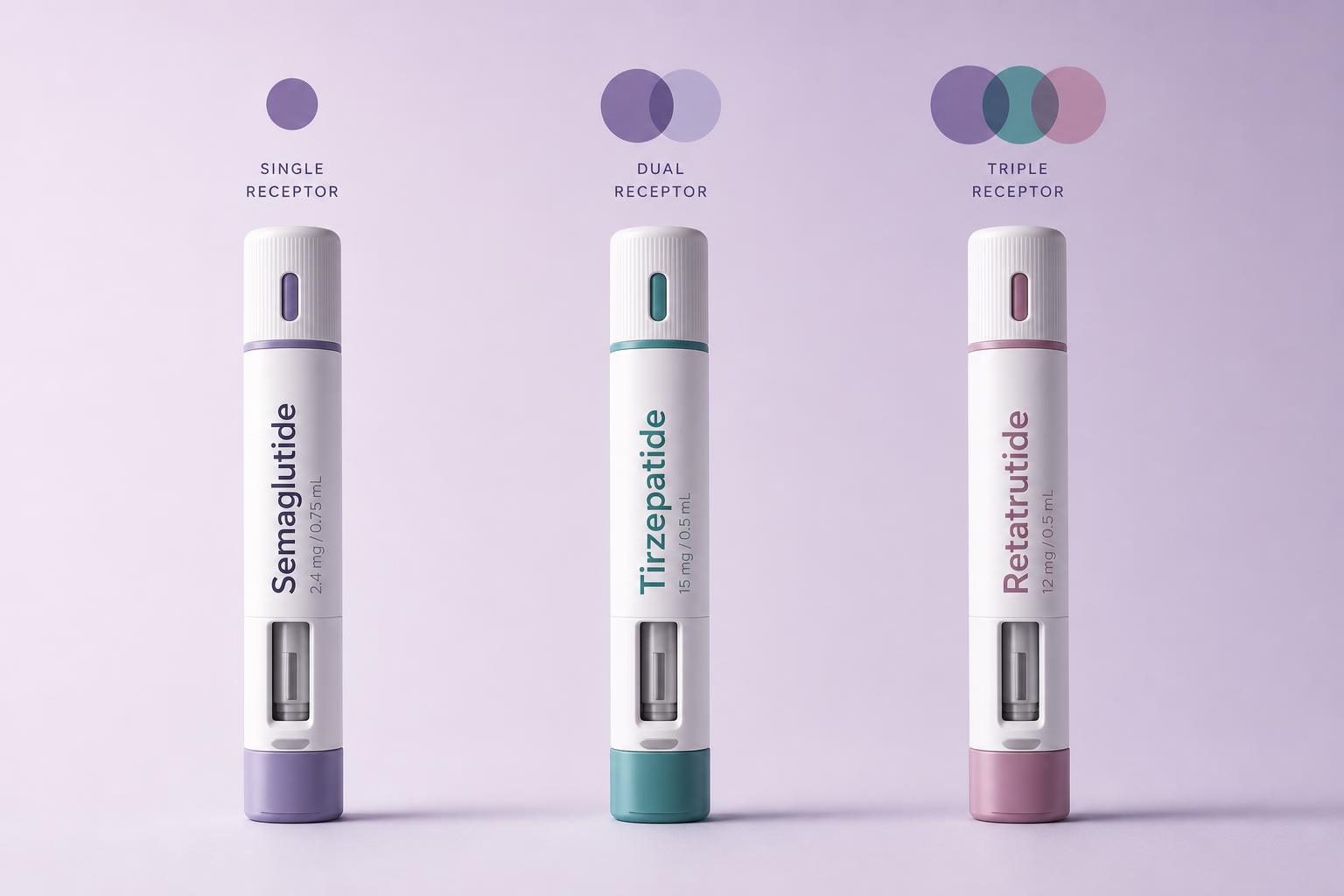
Not all GLP-1 medications are the same. The three you'll hear about most are semaglutide, tirzepatide, and retatrutide. They share a foundation but differ in how aggressively they shift your metabolism. Here's the honest breakdown.
Semaglutide
Semaglutide is a single-receptor GLP-1 agonist — meaning it mimics one of the hormones your body naturally produces after a meal. It quiets appetite, slows how quickly your stomach empties so you feel full longer, and helps regulate blood sugar. It's the most established of the three with the longest real-world track record, and it's often the first stop for people who are new to this class of medication or who want a steady, predictable starting point.
Tirzepatide
Tirzepatide is a dual agonist — it activates both GIP and GLP-1 receptors. That second mechanism is what sets it apart: layering GIP on top of GLP-1 creates a stronger metabolic response than either alone. In practice, that tends to translate into greater weight loss outcomes and noticeably improved insulin sensitivity. It's a great fit for people who want a meaningful step up from semaglutide or who haven't gotten the response they were hoping for on a single-pathway therapy.
Retatrutide
Retatrutide is the newest of the three and the most aggressive — a triple agonist that hits GIP, GLP-1, and glucagon receptors all at once. The glucagon piece is the difference-maker: it directly increases energy expenditure. Early data shows the most significant fat loss results of any GLP-1-class therapy to date, which is why we think of it as a next-generation option for people who want maximum effect and are ready for a more intensive protocol.
| Medication | Mechanism | Primary Benefit | Best Candidate | Relative Strength |
|---|---|---|---|---|
| Semaglutide | GLP-1 agonist | Appetite control, blood sugar | New to GLP-1s, wants a steady starting point | Foundational |
| Tirzepatide | Dual GIP / GLP-1 agonist | Greater weight loss + insulin sensitivity | Wants a stronger response or plateaued on semaglutide | Advanced |
| Retatrutide | Triple GIP / GLP-1 / glucagon agonist | Maximum fat loss + energy expenditure | Ready for the most aggressive protocol | Next-generation |
Practical Application — What This Actually Looks Like
All three medications are delivered the same way: a small subcutaneous injection, usually once a week, done at home with a fine-gauge needle that most people barely feel. Dosing starts low and titrates up over several weeks so your body has time to adapt.
Weeks 1–2: You'll likely notice your appetite quieting down within the first few days. Some people feel mild nausea, a little fatigue, or some indigestion as their system adjusts. These early effects are normal and almost always fade as you settle into the dose.
Month 1: Appetite suppression becomes consistent. Cravings ease. You're eating less without white-knuckling it. Early weight loss often shows up here.
Month 2: The rhythm clicks. Energy stabilizes, food becomes a tool rather than a focus, and the scale typically moves at a steady, sustainable pace.
Month 3 and beyond: This is where the body composition shifts you actually see in the mirror start to show up — provided you're training and eating with intent (more on both below).
How Long Should You Use These Therapies?
GLP-1s are not a quick fix, and they're not meant to be used forever by default. How long you stay on a protocol depends on your goals, your starting point, and how your body responds.
- Short-term (3–6 months): Targeted fat loss — useful when you have a specific goal in mind and a clear endpoint.
- Medium-term (6–12 months): Meaningful body recomposition and metabolic reset. This is the sweet spot for most people who want lasting change.
- Long-term / maintenance: Lower-dose use to manage ongoing metabolic health, often for people with insulin resistance, prediabetes, or a history of yo-yo weight cycles.
The goal is always to reach a point where your lifestyle sustains your results. The medication is a tool — not a crutch — and a good provider will be planning your exit from day one.
Tapering — How to Dose Down Without Losing Your Progress
Tapering matters because stopping cold turkey is one of the fastest ways to experience rebound. Your appetite returns quickly, your metabolic environment shifts, and the lean mass you worked to preserve becomes harder to hold onto. A smart taper gives your body time to adjust to higher hunger signals while your habits do the heavy lifting.
A general framework looks like this:
- 4–8 week gradual dose reduction at the end of your protocol, stepping down rather than dropping off.
- Signs you're ready to taper: you've hit your goal, your habits around food and training are dialed in, and your weight has been stable for several weeks.
- What to watch for during the taper: rising hunger, cravings creeping back, energy dips, or weight regain. Small shifts are normal; rapid changes are a signal to slow the taper down.
- Work with a provider through this phase. Stopping abruptly without guidance is the most common reason people lose progress.
How to Eat While on GLP-1 Therapy
Your appetite will be lower — sometimes a lot lower — and that makes every bite matter more. The biggest mistake we see is people eating too little and accidentally losing muscle along with fat. Here's how to do it right.
- Prioritize protein above everything else. Protein preserves muscle, keeps you full, and has the highest thermic effect of any macronutrient. Aim for a palm-sized portion (or more) at every meal — eggs, chicken, fish, lean beef, Greek yogurt, cottage cheese, or a quality protein shake.
- Don't under-eat. Appetite suppression makes it easy to drop into a calorie hole that costs you muscle and energy. If you're not hungry, you still need to eat — just eat well.
- Focus on whole foods, fiber, and hydration. Vegetables, fruit, legumes, and water keep digestion smooth (especially important on a medication that slows gastric emptying).
- Keep meal structure simple. Two to three protein-forward meals a day works for most people. No need for strict tracking unless you genuinely enjoy it.
- Low-appetite days: hit a minimum protein target (think 0.7–1g per pound of goal bodyweight), and lean on liquid nutrition — a smoothie or protein shake — when chewing feels like too much.
How to Train While on GLP-1 Therapy
The medication handles the metabolic environment. Training is what shapes the body you see at the end of it. Skip this part and you'll lose weight — but not the way you want to.
- Resistance training is non-negotiable. Three to four sessions a week, focused on compound lifts (squats, hinges, presses, rows, carries). This is what preserves lean mass while you're in a deficit.
- Cardio is a tool, not the focus. Two to three sessions of low-to-moderate intensity — walks, easy bike rides, light intervals — is plenty. More than that, and recovery suffers.
- Manage recovery. Training in a caloric deficit is taxing. Sleep, hydration, and protein matter more than program complexity. Don't try to PR every week.
- Ramp intensity as energy returns. Around months 2–3, most people feel noticeably stronger and more energetic. That's the right time to push harder — heavier loads, more volume, longer sessions.
The Bottom Line
GLP-1 therapy is one of the most effective tools available right now for fat loss and metabolic health. But the results that last — the ones that change how you look, feel, and live — come from pairing the medication with the right nutrition, training, and provider guidance. If you're curious whether semaglutide, tirzepatide, or retatrutide is the right fit for you, we'd love to talk through it.
Ready to find out which therapy fits you?
Book a consultation with the Prime Wellness Rx team and we'll build a protocol around your goals, your starting point, and your life.
Book a Consultation